Casagrand Moondance Kumbalgodu Reviews
Casagrand Moondance Kumbalgodu is in its launch phase. Resident reviews don't exist yet, so this page is an editorial read of what the project gets right, what buyers are weighing, and the open questions any serious prospect should resolve before signing the booking cheque. It is intentionally written to be useful to a cautious buyer, not to a marketing campaign. For buyer-fit reading, Casagrand Sunside is useful because the right project for an investor can still be wrong for an end user, and the review has to separate those cases.
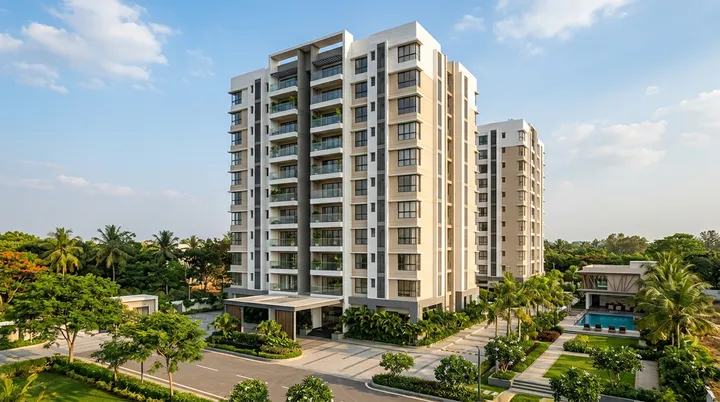
Why buyers are engaging with this launch
Three factors explain the early buyer interest. First, the all-inclusive price discipline: the headline ₹75 Lakhs for the 2 BHK is a genuine all-in number, not a basic-price lure with hidden charges. That signal - that the developer is willing to publish an all-inclusive rate - is unusual in the Bengaluru mid-market and is the single fastest way to build buyer trust. Second, the low-rise format: 504 units on 8.6 acres at B+G+4 with 4.5 acres of open space and 3 grand central courtyards is rare at this price point in Bengaluru; most value-segment launches push vertical to optimise land cost, and the lived-in feel of a low-rise community is materially different from a fifteen-storey tower community. Third, the Casagrand brand: a multi-city developer with a delivery history reduces the perceived risk of buying a pre-launch apartment relative to a first-time developer's project.
What the project gets right (as designed)
Site planning. The master plan's insistence on a pedestrian courtyard, perimeter vehicular movement, and a central amenity precinct is a proven formula for long-term resident satisfaction in Bengaluru mid-market communities. Low-rise buildings remove the elevator-wait and fire-safety anxieties that taller projects carry for ageing residents.
Typology mix. The two-typology mix - only 2 BHK and 3 BHK, no 1 BHK - targets the project's likely resident profile (nuclear and growing families, mid-career professionals) rather than spreading inventory thin across too many typologies. The 2 BHK anchor and the family-format 3 BHK ensure the community has a coherent age-and-household-size distribution.
Price transparency. Publishing the ₹75 Lakhs all-inclusive figure, and being explicit that it covers basic + other charges + GST, raises the bar on how mid-market Bengaluru projects should quote price. It also makes side-by-side comparisons with adjacent launches materially easier for buyers.
Connectivity position. The NICE Road proximity and the Mysore Road metro-corridor exposure give residents a real commute option without requiring a tier-two satellite-town infrastructure bet. Kumbalgodu has working road, rail (via Mysore Road) and metro connectivity - not all at world-class quality, but all functional.
Open questions worth asking before booking
- What is the RERA registration number? Confirm the Karnataka RERA ID in writing. Do not pay a booking amount against a project that has not issued a RERA-registered apartment number.
- What is the specific possession date on the agreement? The sales narrative will quote a window; the registered agreement-for-sale carries the enforceable date. Ask for the exact date clause before signing.
- What is the sanctioned carpet area for the typology? Get the RERA carpet-area statement for your specific unit, not the project-average number. Loading factors vary unit-to-unit within the same typology.
- What are the floor-rise and PLC bands? These are normal in Bengaluru but vary significantly. Ask for the sanctioned slabs so you can compare unit pricing across floors and facings apples-to-apples.
- What is the projected maintenance rate? The first-year maintenance per-sqft-per-month figure determines whether the amenity programme is fundable in year three and beyond. A number below Rs. 3.50/sqft/month for a 504-unit community with a full amenity list is optimistic.
- What is the specification sheet? Kitchen brands, bathroom fittings, door/window systems, flooring sizes. Get the document annexure to the agreement, not the marketing-brochure line items.
- Who are the pre-approved lenders? Pre-approval reduces home-loan processing time and fees. Casagrand's mid-market projects typically carry SBI / HDFC / ICICI pre-approval - confirm and collect contact details.
- What is the penalty clause for delivery delay? RERA mandates a delay-interest provision; confirm the rate and the commencement date for penalty accrual.
How to benchmark before you commit
Run three parallel checks over a weekend. First, visit two comparable Casagrand projects in Bengaluru that have already been handed over - walk the common areas, note the maintenance state at two-to-three years post-possession, talk to the security desk about complaint-resolution rhythm. Second, do the Kumbalgodu commute at 8:45 AM on a Monday to your actual workplace - not a Google-Maps estimate. If you are within 45 minutes door-to-door, the location works; if you are at 75+ minutes, reconsider. Third, pull up two adjacent launches in the same price band (use the pricing page peer-comparison table as a starting point) and normalise everything to rupee-per-carpet-sqft - not per-SBA - before deciding.
Bottom line
Casagrand Moondance Kumbalgodu is a credible launch-phase proposition for the cautious mid-market Bengaluru buyer whose commute geometry works on the southern-and-western spine (Electronic City, Global Village Tech Park, RR Nagar, City core). The low-rise format, the all-inclusive pricing, and the Casagrand brand combine into a structurally sound thesis at ₹75 Lakhs all-in for the 2 BHK. The work for the buyer is not deciding whether the project is good - it plausibly is - but whether the Kumbalgodu location fits their specific life geometry, and whether they can hold the 48-month construction window patiently. Do the commute test, insist on RERA and agreement clarity, and you are ready to make the call.
What a cautious buyer should budget for timing
Buying a launch-phase apartment is, in part, a timing bet. Two calendar habits pay off. First, the 90-day rule: from first enquiry to booking amount cheque should stretch across at least 90 days. That gives you time to do one commute-test drive at peak hour, one weekend site visit, one independent legal check of the RERA documents once issued, one conversation with two existing Casagrand residents at a handed-over project, and at least one alternative-project side-by-side read. Buyers who compress this to 30 days miss diligence steps they later wish they hadn't.
Second, the 60-month mental window. Even with launch-to-handover at a realistic 36–42 months and a 3–6 month buffer for society-formation and interior fit-out, you should assume five years from booking cheque to living in the home. That window should be financially survivable without the apartment - meaning no critical housing, schooling, or employment dependency that the delivery timeline is allowed to break. If any part of the five-year window feels fragile, a ready-to-move-in resale in the same micro-market is a better fit than a launch-phase booking, even at a 10–15% per-sqft premium.
None of this is specific to Casagrand Moondance Kumbalgodu - it is how any launch-phase Bengaluru project should be approached. The project-specific answer sits elsewhere on this site: the overview for positioning, the location for commute math, the pricing for money math, and the for the practical follow-ups. Use them in that order and you'll arrive at the sales office with the right questions.
Get the project deck and start due diligence
We'll share the full brochure, the RERA and sanction documents once available, and the specification annexure so your due diligence can run on paper rather than on promises.
Talk to a Sales ConsultantFrequently Asked Questions
Casagrand Moondance Kumbalgodu Reviews - Frequently Asked Questions
It is suited to a Bengaluru-based IT professional investor whose commute destination is Electronic City or Global Village Tech Park, looking for a self-use home that doubles as a long-hold appreciation play. Expect gross rental yields in the 3.6–4.5% band for the 2 BHK at the ₹5,399/sqft offer rate, at the high end of what greater Bengaluru currently delivers.
The 504-unit, ~59-units-per-acre density is well below Bengaluru's mid-market norm, the configuration mix is intentional with only 2 BHK and 3 BHK (no 1 BHK), and the ₹5,399/sqft offer rate is a meaningful discount to the ~₹7,499/sqft comparable market rate. RERA registration (PRM/KA/RERA/1251/310/PR/200526/008667) is in place.
Three risks: launch-to-possession execution can slip beyond the contractual window so build a 3–6 month buffer, the Metro Purple Line extension timeline is outside the developer's control, and competing mid-market launches in Kumbalgodu over 18–24 months may pressure the rate card and resale premium.
Most peer launches run 100–130 units per acre with even 1/2/3 BHK splits and headline prices that exclude 12–18% of charges. Casagrand Moondance Kumbalgodu sits at about 59 units per acre, offers only 2 BHK and 3 BHK (no 1 BHK), and publishes three rates side by side - an Offer Price of ₹5,399/sqft, a Casagrand Price of ₹5,599/sqft, and a comparable Market Price of ₹7,499/sqft - for an explicit discount logic.
It is not built for buyers chasing a Whitefield or Indiranagar lifestyle, or for professionals whose primary commute is to the eastern tech belt (Marathahalli, Bellandur, Sarjapur). The drive time from Kumbalgodu eastward, even on a clear day, runs 60–80 minutes - that is a disqualifying factor for daily east-Bengaluru commuters.
For a buyer whose commute works and who is comfortable with an 18–24 month launch-to-handover window, the project holds together as a credible mid-market play. Confirm RERA registration, the dated sanction plan, and the registered possession date in writing before any booking amount changes hands.