Casagrand Moondance Kumbalgodu Amenities
The amenity programme at Casagrand Moondance Kumbalgodu is built around a central clubhouse, a landscaped open-space core, and a set of wellness, sports, family and sustainability features sized for a 504-unit low-rise community. The design emphasis is on everyday use over trophy features - a pool you'll actually swim in, a gym that won't be crowded at 7 AM, and play zones close enough to home that children can use them without supervision. Casagrand Sunside is useful because amenity value depends on how often residents will use the facilities, how they are maintained, and whether the operating cost feels justified.
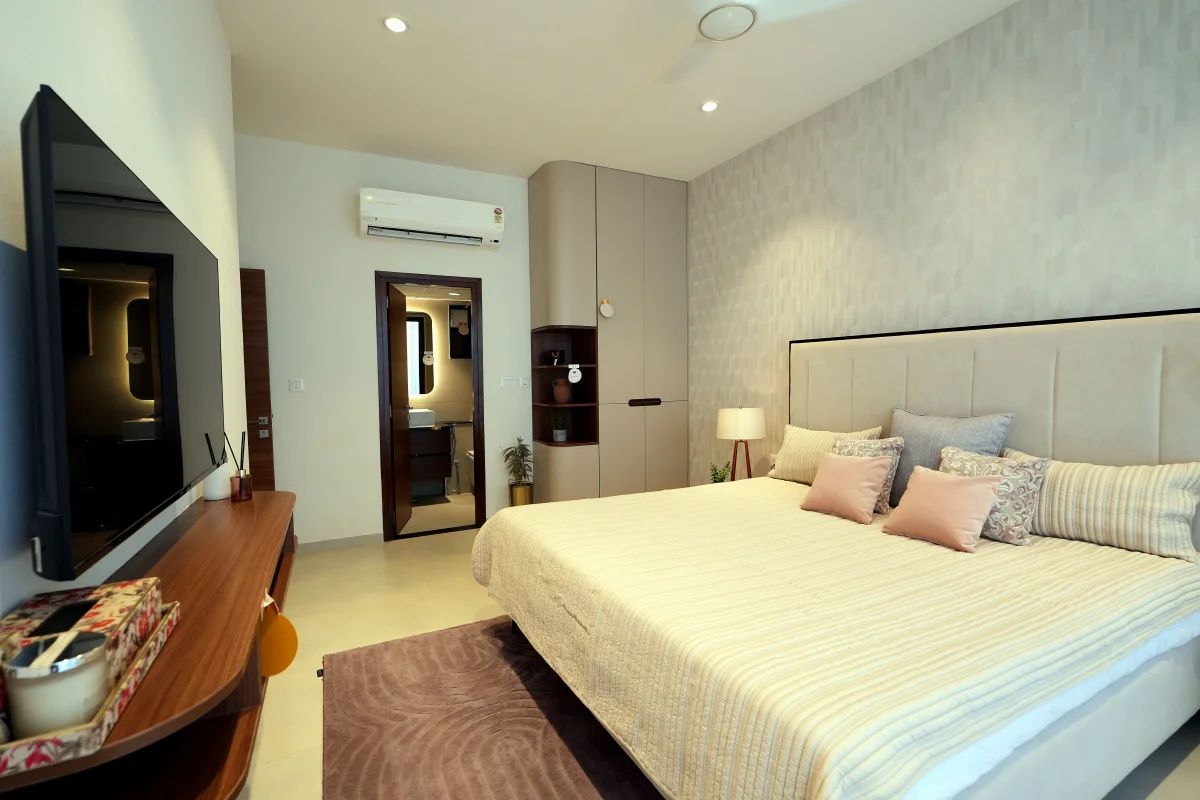
The headline amenities
- Clubhouse - fully equipped social hub with indoor games, banquet, multipurpose hall.
- Swimming Pool - lap and leisure pools for fitness and casual use.
- Gymnasium - modern cardio and strength equipment with a functional-training zone.
- Children's Play Area - age-appropriate safe play zones within the central courtyard.
- Landscaped Gardens - native-plant palette across the central open-space core.
- Jogging Track - dedicated ~400 m circuit through the landscaped grounds.
- Indoor Games Room - table tennis, carrom, chess, pool table.
- Multipurpose Hall - banquet-grade space for resident functions and events.
- 24×7 Security - manned gates, boom barriers, visitor management.
- Power Backup - 100% backup for common areas and essential circuits.
- Covered Parking - basement and stilt parking with EV-charging provision.
- CCTV Surveillance - coverage across all common areas and entry/exit points.
The clubhouse - floor by floor
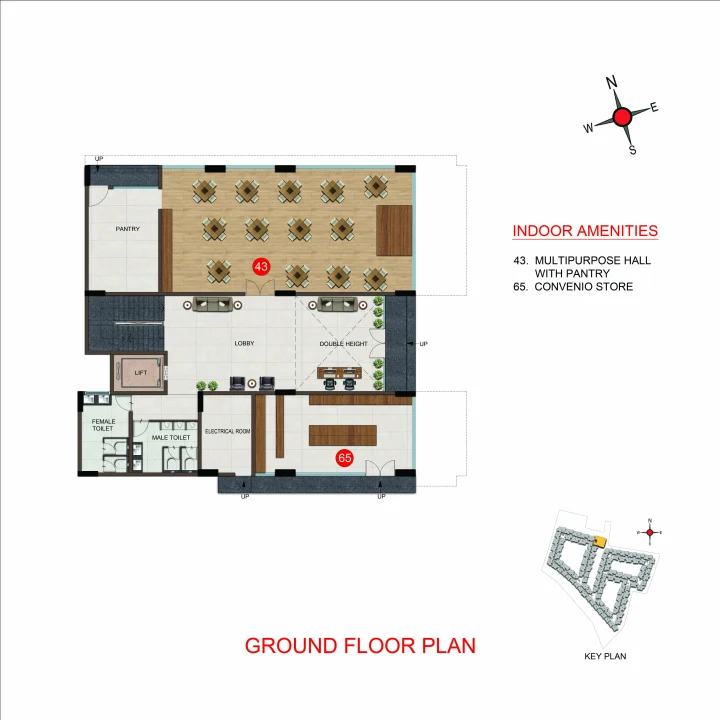
The Casagrand Moondance Kumbalgodu clubhouse is the social heart of the project. The ground floor carries the main lobby, reception desk, the swimming pool deck and the children's play area, so arrival and departure flows are intuitive for residents and guests alike. The first level typically hosts the gymnasium, aerobics and yoga studios, with glass-walled views onto the central landscape so workouts feel less like a basement-gym experience. The upper clubhouse level is reserved for indoor games, a banquet hall, and the multipurpose room used for resident meetings, birthday parties and small cultural events.
A good diagnostic when you visit the clubhouse: ask about the operating hours, the key-card access discipline, and the housekeeping schedule. Facilities deteriorate when access is unlimited and maintenance is thin; Casagrand's management company runs a structured daily-cleaning and monthly-deep-clean rhythm that is worth asking to see on paper at the site visit.
Clubhouse - drawings, floor-by-floor
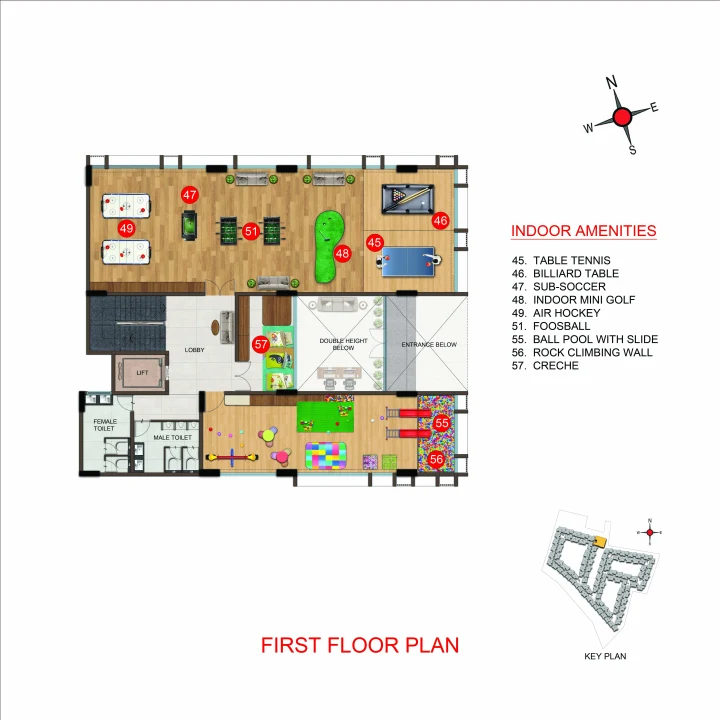
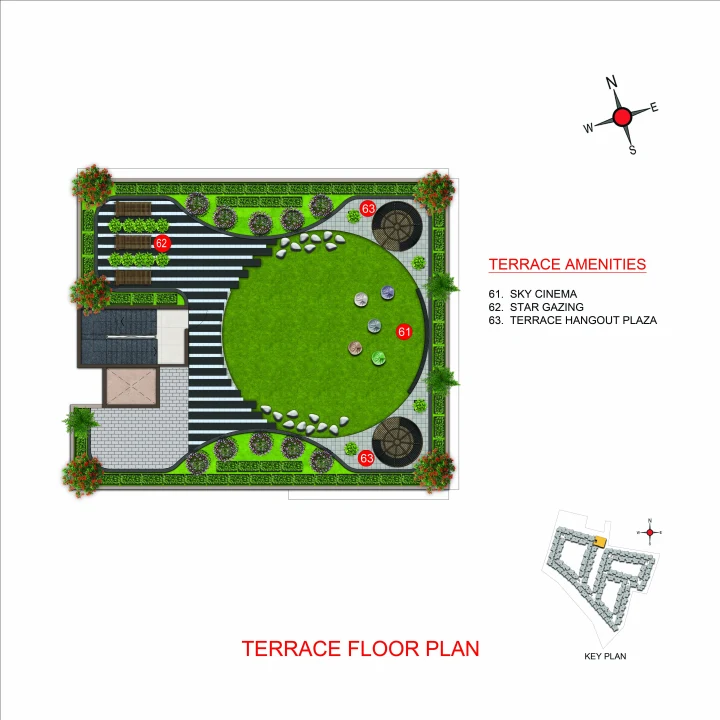
Below are the three distinct sanctioned drawings for the 20,300 sqft clubhouse. The ground floor is the arrival storey - lobby, pool deck and children's play area. The first floor is shown as the representative upper-clubhouse plate (the second and third floors share the same footprint, programmed for indoor games / banquet and mini theatre / co-working / learning centre respectively). The terrace is the rooftop programming - sky cinema, star-gazing deck and terrace hangout plaza.
Wellness and fitness
The wellness brief at Kumbalgodu is built around daily-use capacity rather than show-piece scale. The gymnasium is sized to comfortably serve 15–25 simultaneous users - realistic for a 504-home community - with a mix of cardio machines, a full free-weight rack, and a functional training corner for kettlebell, TRX and mat work. Aerobic and yoga studios are partitioned so a morning yoga class does not conflict with a Zumba session; most Casagrand sites also run a free-of-cost yoga programme through the first 12–18 months post-handover as a community-building measure.
The swimming pool is specified in the lap-plus-leisure format, with a separate shallow section for children. Water is filtered and chlorinated to the standard pool-chemistry thresholds, and attendants are rostered through peak hours. Pool access is typically 6 AM to 9 PM; precise schedules firm up at handover.
Sports and active play
The active-play programme at Kumbalgodu is built around the jogging track, a cricket or badminton net depending on final site planning, indoor table tennis and carrom, and an outdoor games zone typically configured for half-basketball or half-court tennis depending on resident demand at commissioning. For a family cohort with school-age children, the jogging track and the open landscaped grass zones are the most used spaces - the formal sports courts see use but rarely become daily amenities the way a good landscape circuit does.
Bicycle-friendly internal roads and a low-speed 20 km/h speed discipline through the residential loops make the site usable for children's cycling from age 6 upward without parental supervision anxiety. The perimeter-only vehicular movement is the single biggest enabler of this - parents consistently flag pedestrian-only courtyards as the feature they didn't know to ask for until they lived in one.
Family and kids
The children's amenity programme covers three age bands deliberately: a toddler-safe play area with soft-fall flooring and age-appropriate equipment (ages 2–5), a primary-school play zone with a mix of climbing, swinging and imaginative-play fixtures (ages 6–10), and pre-teen oriented zones - badminton, cycling, open grass - suitable for ages 11–15. Parent-friendly seating is distributed across the play areas so the parent doesn't have to abandon supervision to find a bench.
The multipurpose hall doubles as a birthday-party venue, a study-group space during exam season, and a community-event hall during festivals. This is the single most-booked common space in most Casagrand communities and benefits from an advance-booking discipline that the resident association sets up in the first 6–12 months post-handover.
Sustainability and security
Sustainability features across Casagrand Moondance Kumbalgodu include rain-water harvesting with storage designed for dry-season buffer, an on-site sewage treatment plant producing treated water for landscape irrigation and flushing use, native-plant landscaping reducing irrigation demand by 30–40% over non-native palettes, and LED street and landscape lighting across the common areas. Solar-thermal rough-ins on the terrace are typically not included at this price band; confirm the solar specification in the sale-agreement annexure if it is a decision criterion.
Security is structured around three layers: the external boundary (manned gates, boom barriers, CCTV monitoring), the residential wings (access-controlled entries, lift-to-floor access control where specified, visitor management through a phone-app system), and the apartments themselves (main-door reinforcement, video door phones, intrusion-resistant window grilles on ground-floor units). Emergency response protocols - fire, medical, security - are printed in the handover document and annually drilled through the resident welfare association.
How to evaluate an amenity list
The mistake first-time buyers make is treating the amenity list as a checkbox - if the brochure lists a gym, a pool and a clubhouse, the thinking goes, the community is "fully amenitised." A more useful framework: what is the amenity-to-unit ratio, how thick is the expected maintenance budget, and are the amenities programmed for daily use or only trophy-visit weekend use? A 500-unit community with a 10,000 sqft clubhouse will genuinely feel amenitised; a 2,000-unit community with the same clubhouse will feel crowded. Casagrand Moondance Kumbalgodu's 504 units on 8.6 acres sits in the "right-sized" band - enough people to justify a meaningful amenity programme, few enough that the amenities don't queue.
Maintenance charges, typically billed per-sqft-per-month for mid-market Bengaluru projects, are where the amenity list meets reality. Ask for the first-year projected maintenance rate before booking - a clubhouse-heavy programme with thin maintenance budgeting tends to decay within 24–36 months of handover, while a modest programme with disciplined funding holds up for a decade.
The maintenance budget is the amenity list
Over a ten-year horizon, the single biggest determinant of whether an amenity programme delivers on its launch promise is the maintenance budget. A clubhouse pool at year one is a shining amenity; the same pool at year six, starved of chemical treatment budget and preventative-maintenance contracts, becomes a liability. Ask at the site visit for the first-year projected maintenance rate (per sqft per month), the annual budget for amenity upkeep (clubhouse HVAC, gym equipment refresh cycle, pool chemistry and pump maintenance, landscape refresh schedule), and the corpus reserve strategy for capital repairs in years five and ten.
A well-run 500-unit Bengaluru mid-market community budgets Rs. 3.50–4.25 per sqft per month in year one, escalating at 5–7% annually. Budgets below Rs. 3.00/sqft/month for a full amenity list are optimistic; budgets above Rs. 5.00 suggest either a premium specification or inefficient management. Corpus reserves should target 8–12 months of operating budget held in fixed-deposit form, growing to 18–24 months by year five. These are not numbers the developer has to disclose at launch, but they are numbers a disciplined resident welfare association will work toward from day one.
The master plan walks through the physical planning that determines these costs; the pricing page has the maintenance-corpus and advance-maintenance line items in the all-in cost sheet. Between them you'll have the picture you need to judge whether the amenity programme is designed to age well - which is, in the end, the only thing that matters.
See the amenity map and clubhouse plan
We can share the clubhouse drawings, the amenity-block layout within the master plan, and the projected first-year maintenance schedule so you can size the ongoing running cost accurately.
Talk to a Sales ConsultantFrequently Asked Questions
Casagrand Moondance Kumbalgodu Amenities - Frequently Asked Questions
The project includes a clubhouse and a community amenities package alongside the courtyard and garden-dominated open spaces enabled by the low-rise B+G+4 layout. Exact dimensions, indoor games scope, and the full clubhouse facility list are detailed in the agreement specification annexure.
Specifications include vitrified-tile flooring, modular kitchen provision with granite counter, mid-market bathroom sanitaryware (Jaquar / Roca / Parryware range typical), UPVC or aluminium window systems, and branded main-door hardware. The exact specification annexure is part of the agreement for sale.
Yes. 100% power backup for common areas and essential apartment circuits (lighting, one fan, one AC, refrigerator) is provisioned through an on-site DG system. Water is supplied through combined municipal and borewell sources with an underground sump sized for multi-day buffer.
Sustainability features include rain-water harvesting with dry-season storage, an on-site sewage treatment plant feeding treated water to landscape irrigation and flushing, native-plant landscaping to reduce irrigation demand, and LED street and landscape lighting across common areas.
The 8.6-acre parcel is used horizontally with low-rise B+G+4 wings rather than tall towers. That choice trades height for ground-level amenity space and supports pedestrian courtyards large enough to function as genuine community space rather than glorified setbacks.
The project uses conventional RCC shear-wall construction with solid block or AAC infill, a well-established system suited to B+G+4 residential buildings and the local contractor market. Structural design follows IS-875 wind and IS-1893 seismic codes for the applicable zone.