Casagrand Moondance Kumbalgodu Masterplan
The Casagrand Moondance Kumbalgodu master plan trades height for ground-level amenity. Three B+G+4 residential wings are arranged around a central open-space core, with pedestrian-only interior pathways and perimeter-restricted vehicular movement. 504 homes on 8.6 acres yields roughly 61 units per acre - low density by Bengaluru mid-market standards and the single most consequential choice behind the project's feel. Casagrand Sunside is useful for the site-planning lens because buyers should read open space, movement, parking, and amenity placement as everyday-use details, not brochure decoration.
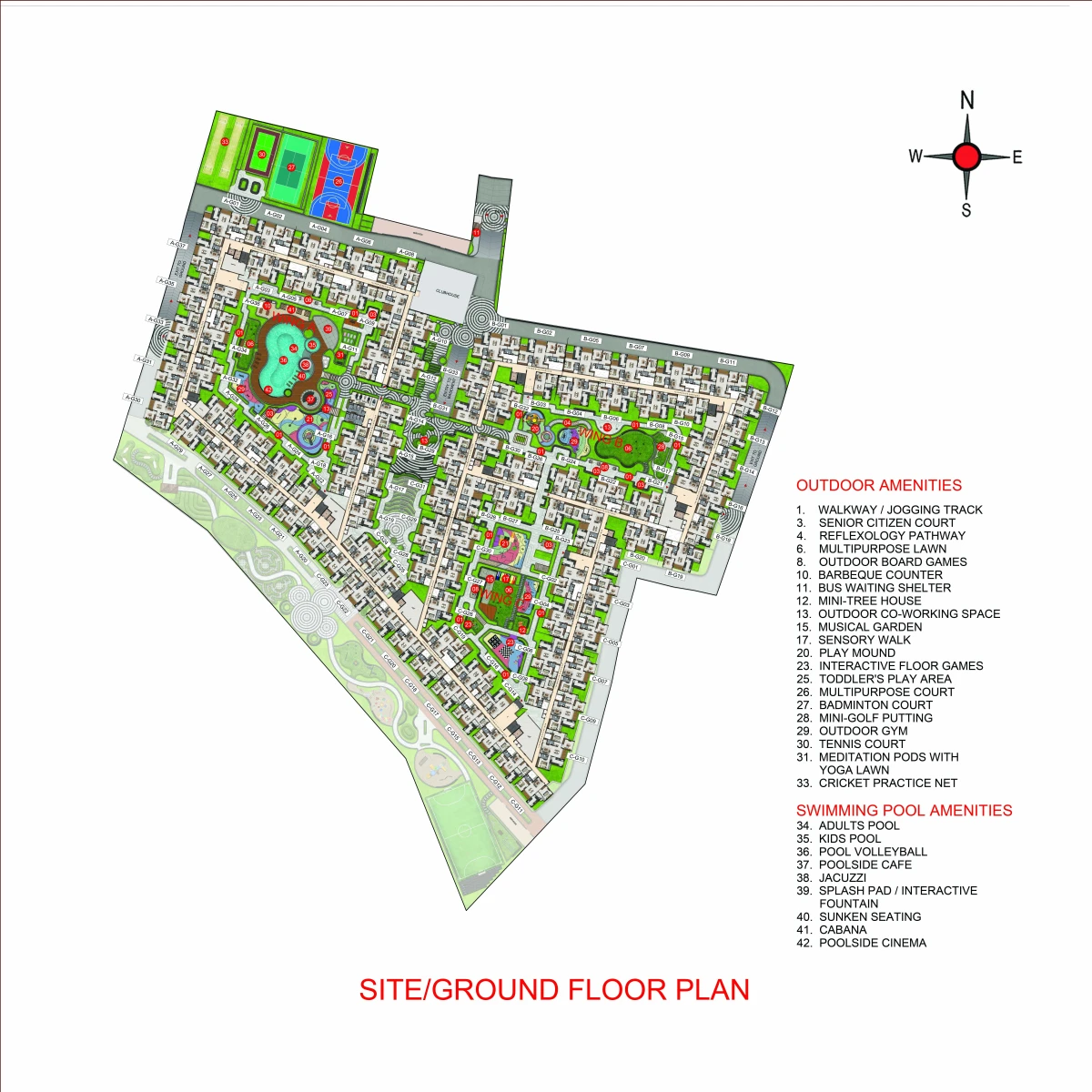
The layout logic - why low-rise wings, why low-rise
At 8.6 acres, Casagrand Moondance Kumbalgodu sits in an unusual sweet spot for Bengaluru: large enough to host a meaningful central amenity precinct (clubhouse, pool, gardens, children's play zones) without feeling sparse, but small enough to keep walking distances short - the furthest apartment door is under a three-minute walk from the clubhouse entrance. The planner's choice to split inventory across low-rise wings rather than consolidate into a single large block is what enables the central open-space arrangement. Each wing can be oriented for cross-ventilation and light independently, and no apartment is shadowed for more than a short morning or evening window by an adjacent wing.
The B+G+4 floor format is the second pivotal choice. A basement accommodates car parking and services; the ground floor carries the lobby, entrance amenity and some utility rooms; and four residential floors above give each wing a clean, horizontal silhouette. The upper floors avoid the lift-wait and elevator-pressure problems that taller towers bring, and the structural engineering is simpler and faster to execute - B+G+4 buildings can be topped out in 14–18 months rather than the 30–36 months a 30+ storey tower takes.
How the 8.6 acres is used
The rough zoning breakdown, as read from the master plan drawing and typical mid-market Bengaluru planning norms, sits in this ballpark:
| Zone | Use | Share |
|---|---|---|
| Residential footprint | Three B+G+4 wings, lobbies, service cores | ~30–35% |
| Central open space | Landscaped gardens, jogging track, play areas | ~25–30% |
| Clubhouse & amenity core | Banquet, gym, pool, indoor games, multipurpose hall | ~6–8% |
| Internal roads & parking approaches | Perimeter ring, drop-off loops, fire tender paths | ~15–18% |
| Setbacks, utility, services | Statutory setbacks, DG, STP, rain-water harvest | ~10–12% |
Confirm the exact numbers on the sanctioned RERA master-plan drawing before booking - the figures above are indicative, drawn from typical Casagrand projects of similar scale, not from a publicly stamped sanction at time of writing.
Traffic, parking and movement
Vehicular entry is perimeter-based, with the drop-off lane wrapping around the wings and basement ramps pulling cars below grade as quickly as possible. The internal courtyard is pedestrian-only - a design language that has become the default for new mid-market Bengaluru launches and which parents of young children single out as the deciding factor on resale viewings. Visitor parking is segregated near the entrance gate so guest vehicles don't pass through resident zones.
Parking is provisioned at one covered spot per apartment across all typologies, with additional visitor and overflow spots on the basement and stilt levels. EV charging infrastructure has been planned at select locations, with capacity for expansion as the society's EV adoption grows - a detail worth asking about in the handover document rather than taking at marketing face value.
Construction technology and specification
Casagrand's Bengaluru portfolio uses conventional RCC shear-wall construction with solid block or AAC infill - a proven, labour-friendly system that suits the four-storey format and the local contractor market better than aluform or pre-cast, both of which are better-suited to 20+ storey developments. Structural frames are designed to IS-875 wind and IS-1893 seismic loads appropriate for Zone II/III classification.
The specification document worth requesting before booking should cover: vitrified flooring sizes and brands, kitchen counter material (granite vs quartz), bathroom tiles and sanitaryware brand bands (Kohler / Roca / Jaquar / Parryware are the typical Casagrand picks), window system (UPVC vs aluminium), and the door frame material for the main and bedroom doors. These items collectively account for 12–15% of the sanctioned build cost and are where developer-to-developer quality differences are most visible at possession.
Services: water, power, waste, security
Water. Combined municipal + borewell + stored-tank supply. Underground sump capacity should be sized for at least two days of full-site consumption; ask for the figure in the services drawing.
Power. BESCOM connection with 100% DG backup for common areas and essential apartment circuits (lighting, one bedroom fan, refrigerator, one AC) across all units. Full-load backup - covering all ACs - is typically not guaranteed at this price band and should not be assumed.
Waste. Two-way segregation at source (wet / dry), an on-site STP sized for full-occupancy flow, and rain-water harvesting across the basement retention tanks. Treated grey-water is recirculated to landscape irrigation and flushing where regulations permit.
Security. Manned gates at the main entry, boom-barrier vehicle access, CCTV coverage across common areas, and visitor-pass integration via an app-based visitor management system. 24×7 manned security presence across the perimeter and the clubhouse access points.
How the master plan translates into buyer-facing outcomes
Three concrete outcomes matter for a buyer reading this page. First, the low density and pedestrian-only courtyard mean children can move through the community unsupervised after age 6–7 in a way that tower-dominated projects do not allow - this is consistently the single most valued amenity by resident families on post-possession surveys of low-rise Bengaluru projects. Second, the B+G+4 format keeps lift wait times under 30 seconds at peak load, which compounds across thousands of daily interactions into a genuinely different quality-of-life experience versus a 30-storey tower. Third, the 25–30% central open-space commitment is what sustains resale appeal - when the next launch in Kumbalgodu inevitably comes up at a higher rate card, this project's landscape will be a decade older and more mature, which the market rewards.
Read the floor plans for how the typologies sit within each wing, the amenities page for what the central precinct actually contains, and the pricing page for how the master-plan advantages translate into the floor-rise and preferential-location charges you'll see on the cost sheet.
Two planning choices that will pay off in year five
Master-plan decisions that look minor at launch often compound over the first five years of resident life. Two at Casagrand Moondance Kumbalgodu worth calling out. First, the decision to place the clubhouse and amenity precinct centrally rather than at the entrance. Entrance-side clubhouses are easier and cheaper to build because they share services infrastructure with the main gate - but they create a two-speed community where residents near the gate use amenities more than residents at the rear. A central clubhouse equalises amenity distance across all low-rise wings, which sustains amenity usage over time and avoids the "empty-pool-on-a-weekday-evening" pattern that hollows out mid-market communities by year three.
Second, the pedestrian-only central courtyard. Perimeter-vehicular circulation is harder to design well (longer basement ramps, more turning radius accommodation, more fire-tender routing) but it is the single biggest quality-of-life lift in a family community. Children move through the grounds safely, elderly residents walk without traffic anxiety, and the landscape becomes a genuinely used space rather than a visual amenity. At year five, communities that made this choice feel noticeably more lived-in than communities that let cars into internal roads - and resale pricing reflects the difference.
The amenities page reads this through the amenity-list lens; the reviews page weighs how these choices sit against the broader launch-phase risk profile. For a buyer evaluating any Bengaluru mid-market project, these two planning diagnostics - central vs entrance clubhouse, pedestrian vs mixed courtyard - are the quickest filters for separating well-planned from serviceably-planned launches.
Building floor-by-floor layouts (basement to terrace)
The B+G+4 building format means each wing has a basement (parking and services), a ground floor (lobby and a small amenity allocation), four residential floors, and a terrace. Below are the three distinct layouts from the sanctioned drawings - basement, a representative residential floor (floors 1–4 share the same stacking layout), and the terrace. Use these to read how individual apartments stack across floors, the position of the staircase and lift core relative to each apartment door, and the orientation of utility risers (plumbing, electrical) within the building footprint.
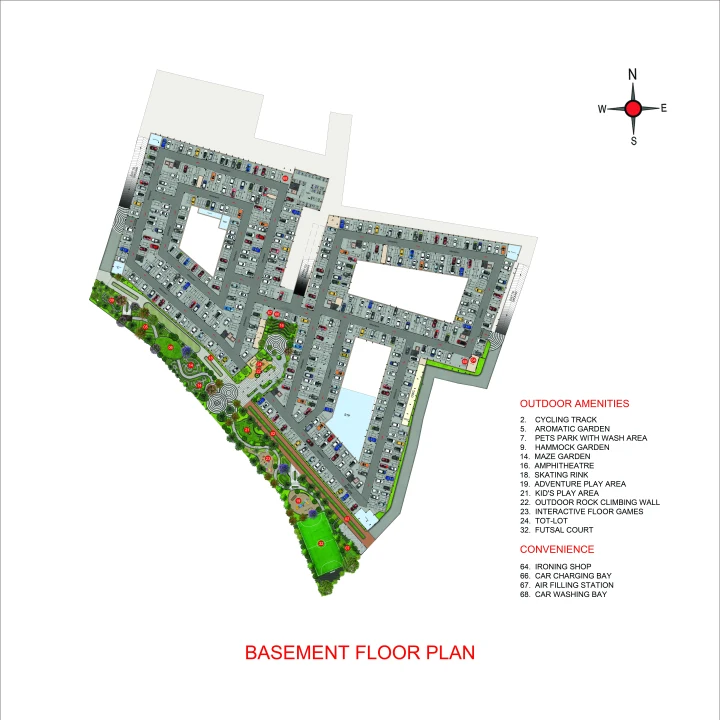
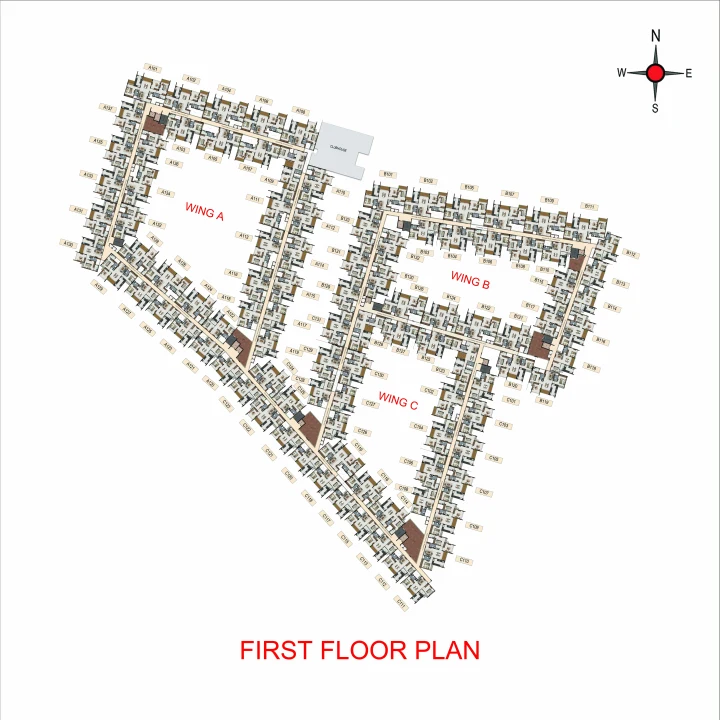
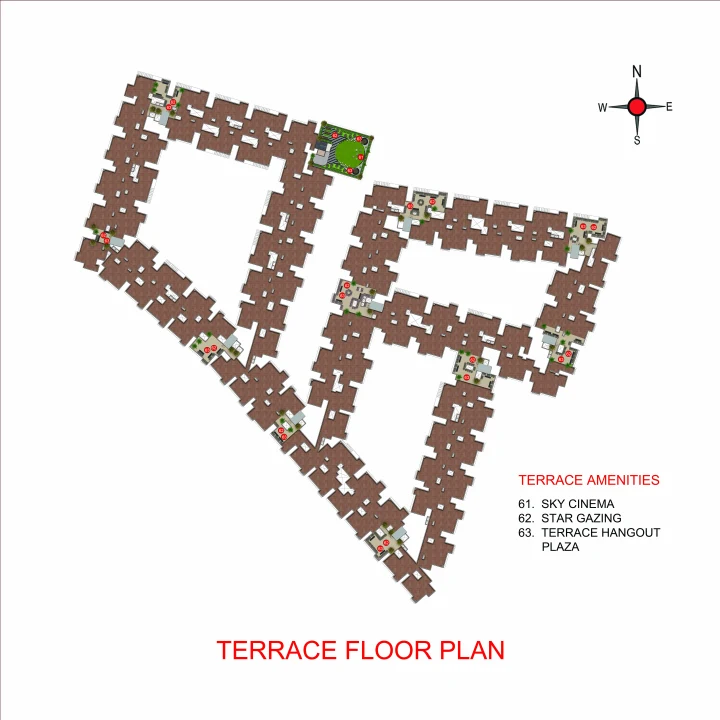
For the unit-level drawings - 2 BHK and 3 BHK typology layouts and the model-flat reference - see the floor-plans page.
Get the annotated master plan and wing map
We can share the sanctioned master-plan drawing, the wing-wise unit numbering, and a walk-through of where clubhouse, pool, gardens, play areas and parking blocks sit on the 8.6-acre site.
Talk to a Sales ConsultantFrequently Asked Questions
Casagrand Moondance Kumbalgodu Master Plan - Frequently Asked Questions
The project is laid out across 8.6 acres with 504 apartments distributed across low-rise B+G+4 wings. Each wing follows a B+G+4 floor structure, making this one of the lower-density mid-market launches in the south-western Bengaluru corridor.
The 8.6-acre land parcel is deliberately used horizontally rather than vertically. Low-rise wings of basement-plus-ground-plus-four floors give the site an open, garden-dominated character rather than the tower-shadow feel of taller high-rises, with height traded for ground-level amenity space.
Density runs at about 59 units per acre, well below the 100–130 units per acre band typical of Bengaluru mid-market high-rise launches. With 4.5 acres of open space organised around 3 grand central courtyards, the resulting open-space share enables pedestrian movement and a garden-dominated community character.
The 504-unit inventory splits between a 2 BHK (1,171–1,470 sqft) acting as the price anchor and a family-format 3 BHK (1,641–1,866 sqft). No 1 BHK is offered in this development - the typology mix is deliberately focused on nuclear and growing families.
The sales and experience centre is at the project site, off Mysore Road, Kumbalgodu, open Monday to Sunday, 10 AM to 7 PM. A consultant can walk you through the master plan, floor plans, cost sheet, and sample-unit viewing where available.
The master plan, sanctioned drawings, and any subsequent revisions are filed with the approving authority and reflected in the registered agreement for sale. RERA registration details and the dated sanction plan should be confirmed in writing before any booking commitment.